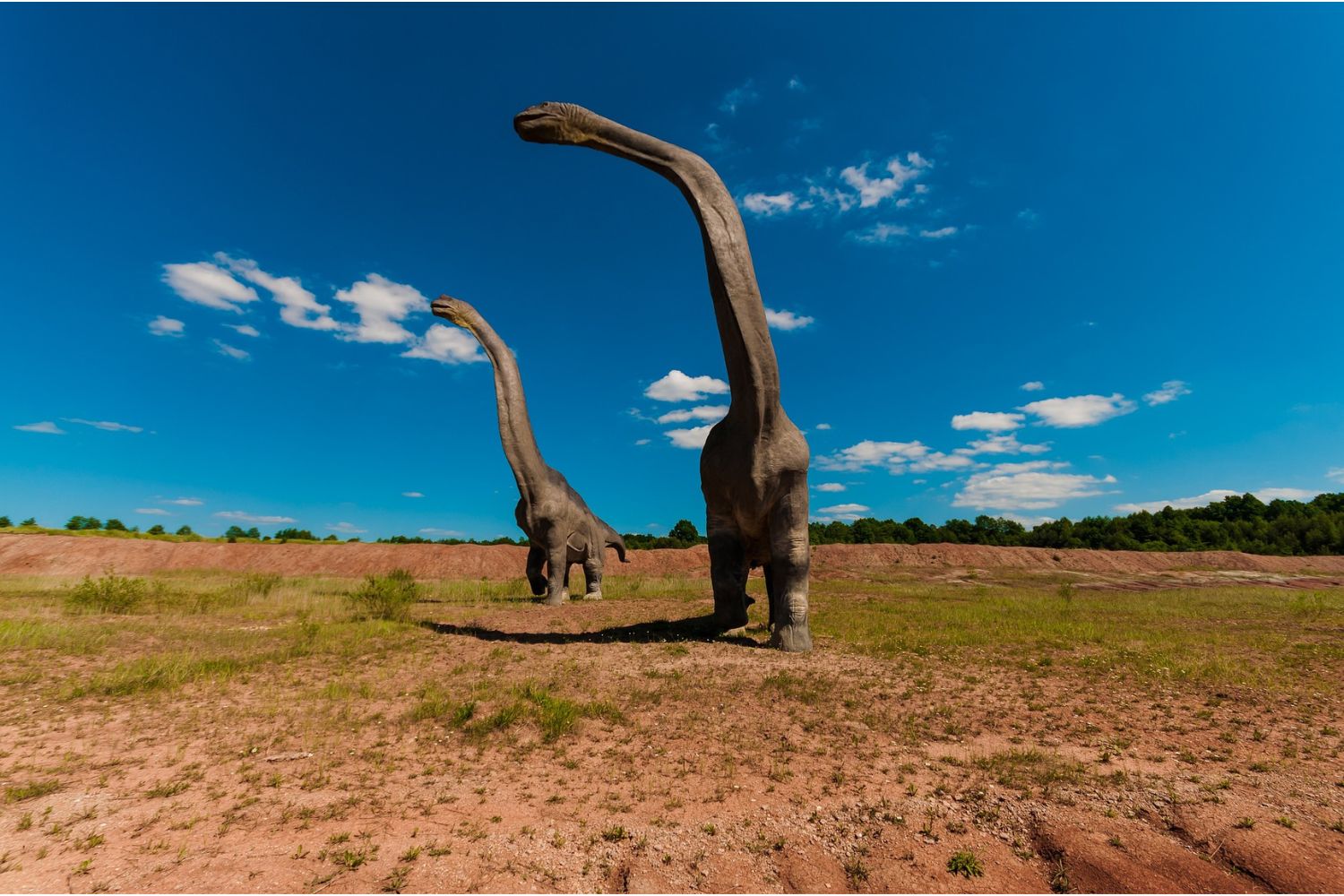
Julien Benoit, University of the Witwatersrand; Cameron Penn-Clarke, University of the Witwatersrand, and Charles Helm, Nelson Mandela University
Credit for discovering the first dinosaur bones usually goes to British gentlemen for their finds between the 17th and 19th centuries in England.
Robert Plot, an English natural history scholar, was the first of these to describe a dinosaur bone, in his 1676 book The Natural History of Oxfordshire.
Over the next two centuries dinosaur palaeontology would be dominated by numerous British natural scientists.
But our study shows that the history of palaeontology can be traced back much further into the past.
We present evidence that the first dinosaur bone may have been discovered in Africa as early as 500 years before Plot’s.
We’re a team of scientists who study fossils in South Africa.
ALSO READ: Fossil snake traces: another world-first find on South Africa’s Cape south coast
Peering through the published and unpublished archaeological, historical and palaeontological literature, we discovered that there has been interest in fossils in Africa for as long as there have been people on the continent.
This is not a surprise. Humankind originated in Africa: Homo sapiens has existed for at least 300,000 years. And the continent has a great diversity of rock outcrops, such as the Kem Kem beds in Morocco, the Fayum depression in Egypt, the Rift Valley in east Africa and the Karoo in southern Africa, containing fossils that have always been accessible to our ancestors.
So it wasn’t just likely that African people discovered fossils first. It was inevitable.
More often than not, the first dinosaur fossils supposedly discovered by scientists were actually brought to their attention by local guides. Examples are the discovery of the gigantic dinosaurs Jobaria by the Tuaregs in Niger and Giraffatitan by the Mwera in Tanzania.
Our paper reviews what’s known about African indigenous knowledge of fossils. We list fossils that appear to have long been known at various African sites, and discuss how they might have been used and interpreted by African communities before the science of palaeontology came to be.
Bolahla rock shelter in Lesotho
One of the highlights of our paper is the archaeological site of Bolahla, a Later Stone Age rock shelter in Lesotho. Various dating techniques indicate that the site was occupied by the Khoesan and Basotho people from the 12th to 18th centuries (1100 to 1700 AD). The shelter itself is surrounded by hills made of consolidated sediments that were deposited under a harsh Sahara-like desert some 180 million to 200 million years ago, when the first dinosaurs roamed the Earth.
This part of Lesotho is particularly well known for delivering the species Massospondylus carinatus, a 4 to 6 metre, long-necked and small-headed dinosaur. Fossilised bones of Massospondylus are abundant in the area and were already so when the site was occupied by people in the Middle Ages.
In 1990, archaeologists working at Bolahla discovered that a finger bone of Massospondylus, a fossil phalanx, had been transported to the cave. There are no fossil skeletons sticking out the walls of the cave, so the only chance that this phalanx ended up there was that someone in the distant past picked it up and carried it to the cave. Perhaps this person did so out of simple curiosity, or to turn it into a pendant or toy, or to use it for traditional healing rituals.
After heavy rains, it is not unusual that the people in the area discover the bones of extinct species that have been washed out of their mother-rock. They usually identify them as belonging to a dragon-like monster that devours people or even whole houses. In Lesotho, the Basotho call the monster “Kholumolumo”, while in South Africa’s bordering Eastern Cape province, the Xhosa refer to it as “Amagongqongqo”.
The exact date when the phalanx was collected and transported is unfortunately lost to time. Given the current knowledge, it could have been at any time of occupation of the shelter from the 12th to 18th centuries. This leaves open the possibility that this dinosaur bone could have been collected up to 500 years prior to Robert Plot’s find.
Early knowledge of extinct creatures
Most people knew about fossils well before the scientific era, for as far back as collective societal memories can go. In Algeria, for example, people referred to some dinosaur footprints as belonging to the legendary “Roc bird”. In North America, cave paintings depicting dinosaur footprints were painted by the Anasazi people between AD 1000 and 1200. Indigenous Australians identified dinosaur footprints as belonging to a legendary “Emu-man”. In South America, the notorious conquistador Hernan Cortes was given the fossil femur of a Mastodon by the Aztecs in 1519. In Asia, Hindu people refer to ammonites (coiled fossil-sea-shells) as “Shaligrams” and have been worshipping them for more than 2,000 years.
Claiming credit
The fact that people in Africa have long known about fossils is evident from folklore and the archaeological record, but we still have much to learn about it. For instance, unlike the people in Europe, the Americas and Asia, indigenous African palaeontologists seem to have seldom used fossils for traditional medicine. We are still unsure whether this is a genuinely unique cultural trait shared by most African cultures or if it is due to our admittedly still incomplete knowledge.
Also, some rather prominent fossil sites, such as the Moroccan Kem Kem beds and South African Unesco Cradle of Humankind caves, have still not provided robust evidence for indigenous knowledge. This is unfortunate, as fossil-related traditions could help bridge the gap between local communities and palaeontologists, which in turn could contribute preserving important heritage sites.
By exploring indigenous palaeontology in Africa, our team is putting together pieces of a forgotten past that gives credit back to local communities. We hope it will inspire a new generation of local palaeoscientists to walk in the footsteps of these first African fossil hunters.
Julien Benoit, Senior Researcher in Vertebrate Palaeontology, University of the Witwatersrand; Cameron Penn-Clarke, Senior Researcher, University of the Witwatersrand, and Charles Helm, Research Associate, African Centre for Coastal Palaeoscience, Nelson Mandela University
*This article is republished from The Conversation under a Creative Commons license. Read the original article.