
New Delhi, India | 1-3 February 2026
Finance Minister Nirmala Sitharaman presented the Union Budget for the 2026-27 financial year to Parliament on 1 February 2026, prioritising substantial increases in infrastructure and capital expenditure while outlining a clear path for fiscal consolidation. The budget, set against a backdrop of sustained economic growth, is widely analyzed as a strategic investment in India’s long-term productive capacity and a move towards greater fiscal discipline.
The government announced a significant increase in public capital expenditure, raising it to ₹12.2 lakh crore for FY27, an approximate 9% increase from the previous year’s budgeted estimates. This marks the fourth consecutive year of a major boost in public capital spending, with the focus on expanding the national highway network, modernising railways including seven high-speed rail corridors and developing multi-modal logistics parks. The aim is to enhance the country’s physical infrastructure, reduce logistics costs, and stimulate private investment, with a particular focus on driving more balanced growth in tier-II and III cities.
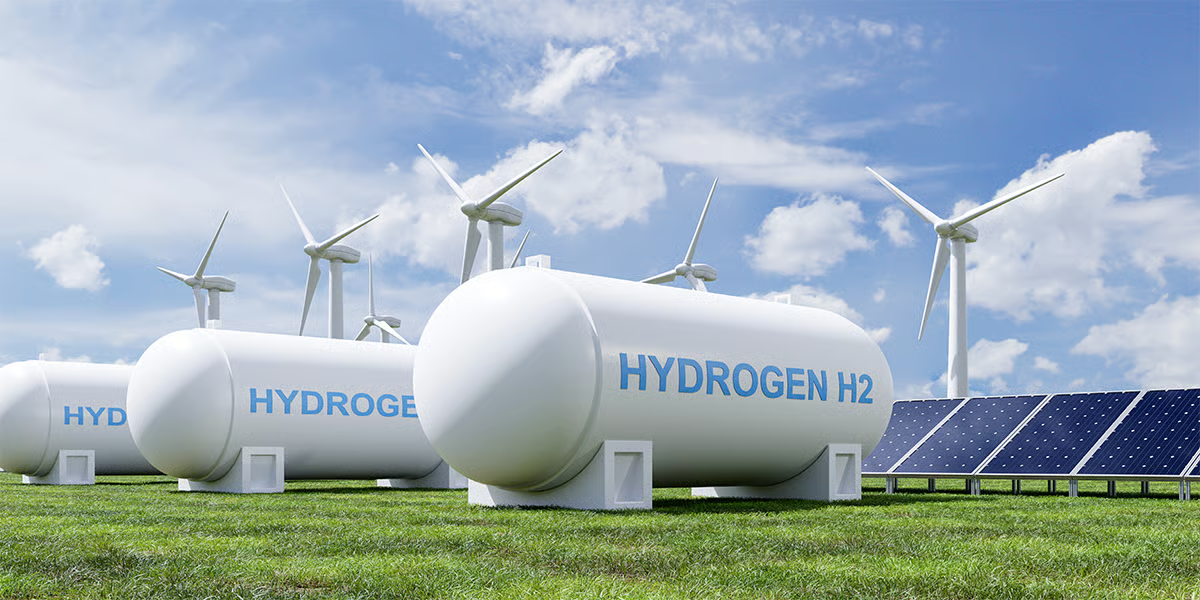
A major cross-cutting theme of the budget is “Green Growth” and energy transition. This is complemented by significant on-the-ground progress under the National Green Hydrogen Mission. As of early February 2026, the government had awarded manufacturing incentives for 3,000 MW of electrolyser capacity annually and production incentives for 862,000 tonnes of green hydrogen per year, laying the foundation for India’s ambition to become a global hub for this clean fuel.
On the fiscal front, the government set an ambitious target to reduce the fiscal deficit to 4.3% of GDP for FY27, down from a revised estimate of 4.4% for FY26. This consolidation is planned to be achieved through a projected growth in tax revenues and is part of a medium-term strategy to align with globally accepted fiscal norms. No major changes were announced to direct tax rates for individuals or corporations, reinforcing a message of policy stability and continuity for investors.
Analysts noted that the budget’s emphasis on capex, technology, and fiscal prudence is designed to reinforce macroeconomic stability, maintain investor confidence, and support the economy’s transition to a higher growth trajectory while managing inflationary pressures.
References:
- Savills. “Union Budget FY 2026-27: Reaction and Analysis.” savills.co.uk, February 2026. https://www.savills.co.uk/research_articles/229130/227054-1
- The Economic Times. “Budget 2026: Sitharaman trims FY27 fiscal deficit target to 4.3%.” economictimes.indiatimes.com, 1 Feb. 2026. https://m.economictimes.com/news/economy/policy/budget-2026-nirmala-sitharaman-trims-fy27-fiscal-deficit-target-to-4-3-percent/articleshow/127831227.cms
- Press Information Bureau, Government of India. “Government Undertaking Measures to Optimise Energy Mix and Reduce Costs for Green Hydrogen Production.” pib.gov.in, 3 Feb. 2026. https://www.pib.gov.in/PressReleseDetailm.aspx?PRID=2222471®=3&lang=1
- Press Information Bureau, Government of India. “Union Budget FY 2026-27: Strengthening Capital Goods Sector.” pib.gov.in, 3 Feb. 2026. https://www.pib.gov.in/PressNoteDetails.aspx?id=157180&NoteId=157180&ModuleId=3
- Federation of Indian Petroleum Industry via Hydrogen Insight. “India’s hydrogen play: Acceleration, scale and global collaboration.” hydrogeninsight.com, February 2026. https://www.hydrogeninsight.com/sponsored-content/fipi/indias-hydrogen-play-acceleration-scale-and-global-collaboration/
- KPMG India. “Budget 2026: Vision for future-ready India with clarity and continuity.” kpmg.com, 4 Feb. 2026. https://kpmg.com/in/en/blogs/2026/02/budget-2026-vision-for-future-ready-india-with-clarity-and-continuity.html